First-Lien HELOCs vs. Traditional Mortgages: Why the Interest Rate Isn't the Number That Matters
Most Hawaii homeowners focus on the interest rate. For disciplined savers, a first-lien HELOC with a sweep account can lower total interest and keep equity accessible. Here's how to compare it fairly.
First-Lien HELOCs vs. Traditional Mortgages: Why the Interest Rate Isn't the Number That Matters
Last Updated: July 2026
Most homeowners assume the only way to pay off a mortgage faster is to make extra principal payments — a strategy that traps your cash inside the walls of your house. But there's an entirely different math engine available in the mortgage market: the first-lien HELOC with an integrated sweep-checking account, sometimes called an "offset mortgage" — a structure that's been common overseas for decades and is offered by a small number of U.S. lenders.
For disciplined savers with strong cash flow, this structure can meaningfully accelerate a payoff timeline while keeping equity fully liquid.
Here's the key idea to walk away with: the number that matters isn't your interest rate. It's the total interest you actually pay. Those are not the same thing, and the difference between them is where this loan category lives.
The Two Math Engines: Monthly Amortization vs. Daily Calculation
If you ask the average Hawaii homeowner how their mortgage interest is calculated, they'll tell you it's based on their rate. That's only half the story. The other half — the part that dictates how much you pay the bank over 30 years — is the math engine running behind the scenes.
A traditional mortgage uses an amortized schedule. Interest is front-loaded: in the early years, the majority of every payment goes to interest, and the principal balance barely moves. You make your payment on the 1st, the bank takes its cut, and you wait 30 days to do it again. If you get a bonus and pay down principal, great — but that cash is now trapped in your equity. Getting it back means selling the house or paying closing costs on a refinance or a second lien.
A first-lien HELOC works differently. It's not a closed-end mortgage at all — it's a home equity line of credit sitting in first lien position on your home's title. Instead of a fixed amortization schedule, interest is calculated on your actual outstanding balance as it moves. On the products built for this strategy, interest is computed daily — often on each day's ending balance — then totaled and billed once a month.
That daily calculation is the whole game. If you can keep your daily balance suppressed, you directly reduce the interest charged that month — without changing your rate and without changing your budget.
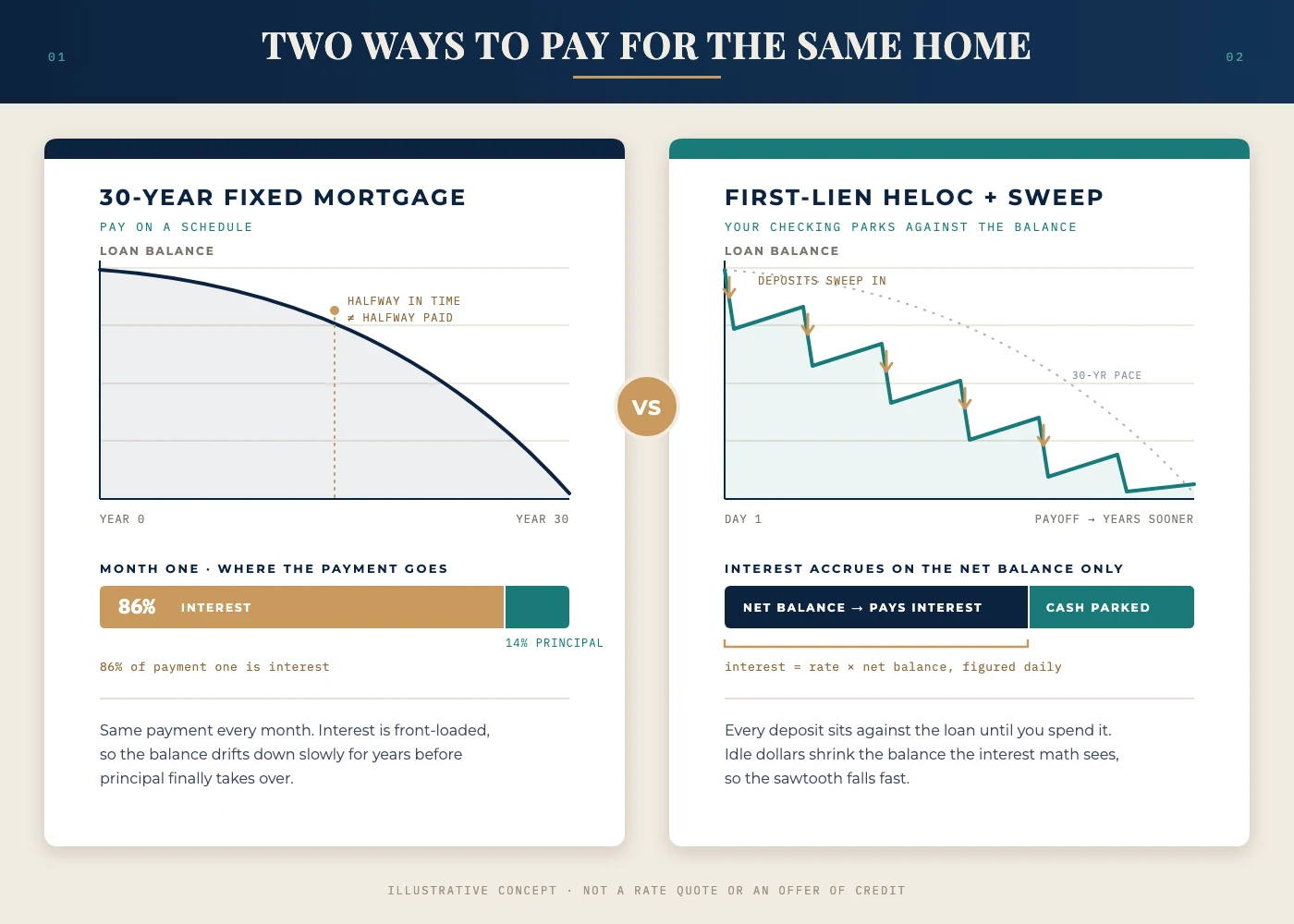
Same income. Same expenses. Different math engine. Different outcome.
The Integrated Sweep-Checking Account
How do you suppress the daily balance? This is what separates a purpose-built offset product from an ordinary HELOC: the loan includes an integrated sweep-checking account designed to replace your everyday banking.
Your paycheck is direct-deposited into the account. The moment it lands, the funds are swept against your loan principal. Your money isn't sitting idle in a checking account earning next to nothing — every dollar is working against your mortgage balance from day one.
Here's what that looks like. Say your loan balance is $600,000. On the 1st, your household's $12,000 in take-home pay hits the account. Your balance drops to $588,000 that night. For the rest of the month, interest is calculated daily on that lower balance. As you pay your normal living expenses — groceries, utilities, the car — you spend directly from the account using a debit card, checks, or online bill pay, and the balance slowly draws back up.
The result is a "sawtooth" pattern: sharp drop on payday, slow creep as you spend. Your average daily balance stays meaningfully lower than it ever would under a traditional structure — and whatever you don't spend stays swept against principal permanently.
No extra payments. No budgeting apps. No behavior change beyond routing your banking through the account. The structure does the work.
The Hawaii Math: Who Benefits Most?
This isn't magic — it's arithmetic, and it requires one specific ingredient: positive monthly cash flow. The bigger the gap between what you earn and what you spend, the larger the effect.
That's exactly why this structure is so relevant here. With Oahu home prices commonly running $600,000 to over $1 million, loan balances are large — and the larger the balance, the more every day of interest suppression is worth. The strongest candidates:
- Dual-income professional households with reliable monthly surplus
- High earners in medicine, law, tech, and federal careers
- Small business owners with consistent monthly distributions
- Real estate investors — some products in this category are available on investment properties, meaning tenant rent deposits can suppress the balance the same way a paycheck does
A Hypothetical Hawaii Scenario
Consider a homeowner with this profile:
- Loan balance: $600,000
- Net monthly income: $12,000 (direct-deposited into the sweep account)
- Monthly expenses: $7,000 (drawn from the account throughout the month)
- Monthly surplus: $5,000
In a traditional setup, that $5,000 surplus sits in checking earning almost nothing — or in a taxable high-yield savings account — while the borrower pays full interest on a static $600,000 amortizing balance.
In the sweep structure, the entire $12,000 suppresses the balance the day it arrives. The $7,000 in expenses draws it partially back up. The $5,000 surplus stays swept against principal, month after month, compounding the effect.
For a borrower who maintains that discipline, depending on income, spending, balance, and rates, this structure can shorten the payoff timeline; it can also cost more if rates rise or surplus shrinks. Actual results depend entirely on your income, spending, balance, and rate environment. The only honest way to evaluate it is a side-by-side simulation of your numbers against a traditional mortgage — comparing total interest paid and payoff date, not note rates.
The Liquidity Advantage: Your Equity Stays Yours
The biggest hesitation homeowners have about aggressive payoff strategies is liquidity. Put an extra $2,000 a month toward a 30-year fixed and yes, you'll pay it off faster — but if you need a new roof, face a medical emergency, or lose a job, that money is locked in the house.
A first-lien HELOC solves this structurally. Because it's a revolving line of credit, every dollar of principal you pay down remains accessible through the account, subject to your credit limit. Your paydown functions like a large, liquid reserve secured by your home. Pay the balance down $100,000 over three years, then decide to fund a child's college or an investment property down payment? You write the check.
One design detail matters a lot when comparing products: the draw period. A standard second-lien HELOC usually gives you 10 years of draw access before it converts to repayment. Products purpose-built for this strategy can offer far longer draw periods — in some cases the full 30-year term — and keep the full credit limit available for an extended stretch before it begins stepping down. When you evaluate any product in this category, ask specifically: how long is my draw period, and when does my available credit start shrinking?
In Hawaii's high-cost environment, having accessible capital without selling or refinancing is a genuine financial advantage — especially for investors watching for the next opportunity.
The Rate Trade-Off: Let's Be Honest About It
If this structure can lower interest, why doesn't everyone use it? Because you have to clear a psychological hurdle: the rate.
First-lien HELOCs are variable-rate products — a published index plus a lender's margin. The starting rate will generally sit above prevailing 30-year fixed rates, and that gap alone stops most borrowers from looking further. Compare the two note rates side-by-side and the fixed rate "wins" every time — on paper. But that comparison is the wrong one.
The comparison that matters is total interest paid and payoff timeline. A higher rate applied to a constantly suppressed, rapidly shrinking daily balance can cost less in actual dollars than a lower rate applied to a static, slowly amortizing balance. That's not opinion — it's arithmetic, and it's exactly what a proper simulation will show you, in either direction.
Is variable-rate risk real? Yes. If rates spike, your rate adjusts upward. But well-structured products in this category build in protections worth asking about:
- Lifetime rate caps that limit how far the rate can rise above your starting rate
- Fixed margins that never change over the life of the loan
- Floor rates, and on some products, initial fixed-rate periods with capped adjustments afterward
- No prepayment penalty and no balloon payment — features you should confirm on any specific product
The other hedge is the strategy itself: rapid principal reduction means a higher rate is being applied to a smaller and smaller balance. And if market rates fall, a variable rate floats down automatically — no refinance, no closing costs, no friction.
Who This Is NOT For
Here's what I'd tell you in my office, because this structure is a precision tool and the wrong borrower in it will get hurt:
- Paycheck-to-paycheck households. If expenses equal or exceed income, there's no surplus to drive the balance down. You'd carry a variable rate with none of the benefit. A traditional fixed-rate loan is the better fit.
- Undisciplined spenders. Your home equity becomes accessible through a debit card. If that access would become a slush fund, this structure will work against you — you could spend your way backward.
- Borrowers who need absolute payment certainty. If a variable rate would keep you up at night regardless of the math, take the 30-year fixed and sleep well. Peace of mind has real value.
Qualification also tends to be more selective than a standard mortgage — lenders offering these products are underwriting for strong credit and demonstrated positive cash flow, since the entire strategy depends on it. Whether you qualify, and whether the math actually favors you, is a conversation with a licensed professional, not a headline.
The Bottom Line
For decades, the mortgage industry has trained buyers and homeowners to shop one number: the rate. But the rate is just an input. Total interest paid is the output — and the output is what you actually write checks for.
If you consistently spend less than you earn, parking your surplus in a low-yield checking account while paying interest on a full, slowly amortizing mortgage balance is mathematically inefficient. A first-lien HELOC with a daily sweep account puts every idle dollar to work against your balance, can accelerate your payoff when your monthly surplus is steady, and keeps paid-down equity accessible.
It's not for everyone. But for the right Hawaii household, it's a fundamentally different way to own a home.
Here's what I'd do in your shoes: don't decide based on an article — this one or anyone else's. Run your actual numbers. Take your loan balance, take-home income, and monthly spending to a licensed loan officer, and ask for a side-by-side simulation showing total interest and payoff date against a traditional mortgage. If the lender can't or won't show you that comparison, keep looking.
Curious whether this strategy fits your situation? I've been running these comparisons for Hawaii homeowners. With 25 years in mortgage lending, I'm happy to walk through your numbers with you — no pressure, no obligation. Reach out anytime at (808) 429-0811 or jaym@cmghomeloans.com.
Frequently Asked Questions
What is a first-lien HELOC? It's a home equity line of credit that replaces your primary mortgage, sitting in first lien position on your home's title. Instead of a traditional amortized loan, it functions as a revolving credit line — often paired with integrated banking features and available for both purchases and refinances.
How does a sweep-checking account work with a mortgage? Your income is deposited directly into an account integrated with the loan, immediately reducing the principal balance. The money remains available for bills and everyday expenses through debit card, checks, and bill pay — but until you spend it, it's lowering the balance your daily interest is calculated on.
How is interest calculated? On products built for this strategy, interest is computed daily on the outstanding balance — often each day's ending balance — then totaled and billed monthly. This is why lowering the daily balance matters more here than on a traditional mortgage's monthly amortization schedule.
Is the rate fixed or variable? Variable — an index plus a margin. Product features vary, so ask any specific lender about lifetime rate caps, whether the margin is fixed for the life of the loan, initial fixed-rate options, prepayment penalties, and balloon payments before you commit.
Can I access my equity after I pay the balance down? Yes — that's the core liquidity advantage. Principal you pay down remains available as open credit during the draw period, subject to your credit limit. Draw period length varies significantly by product, so confirm how long yours lasts and when the available credit begins to reduce.
Who should avoid a first-lien HELOC? Households without consistent positive monthly cash flow, borrowers who lack spending discipline, and anyone who needs the absolute payment certainty of a fixed-rate mortgage. The strategy only works with a genuine monthly surplus.
How do I find out if it makes sense for me? Ask a licensed loan officer to run a side-by-side simulation using your actual balance, income, and spending — comparing total interest paid and payoff timeline against a traditional mortgage. That comparison, not the note rate, is the decision. If you'd like help running your numbers, reach out at (808) 429-0811 or jaym@cmghomeloans.com.
Related Articles
- The All In One Loan™ in Hawaii: how it works and who it fits
- When and How to Refinance Your Hawaii Mortgage
- Understanding Closing Costs in Hawaii
- How Lenders Calculate Income for Mortgage Qualifying
Published by Jay Miller, CMA | NMLS #657301 | CMG Home Loans, Honolulu, Hawaii | RealityCents.com